
Articles
The Neural Engineering of Recovery: How Medication and Behavior Build a New Brain
How medication prepares the brain’s chemistry while behavioral training builds lasting neural pathways for recovery.
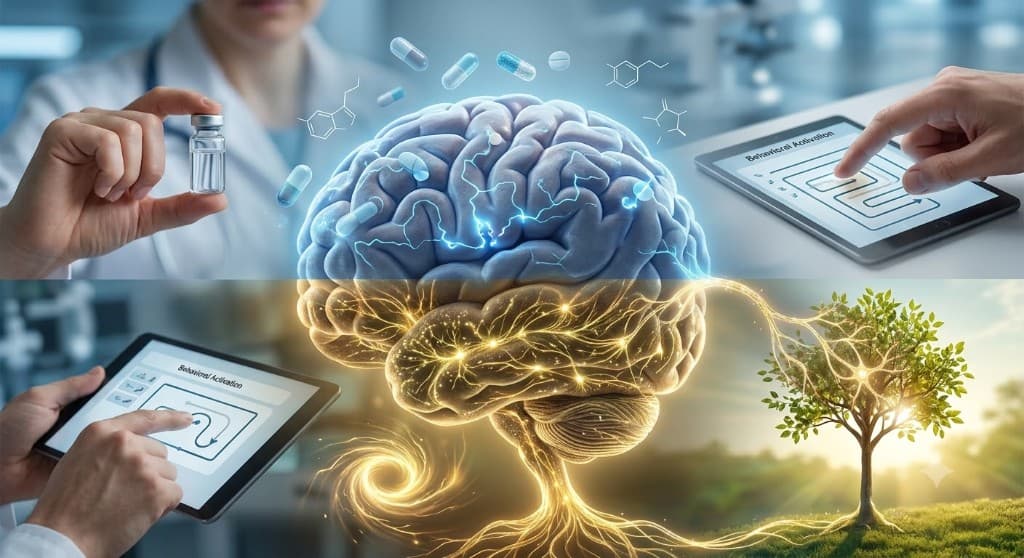
Integrated treatment is a hybrid model: medication as a foundation, and behavioral training as the work that rebuilds neural pathways. Psychiatric medicines enable therapy by preparing the brain’s chemical environment and reducing acute symptoms, but they do not, on their own, create new synapses for positive behaviors.
Hebb’s law and neuroplasticity
Forming new synapses requires a learning process that activates Hebbian learning:
“Cells that fire together, wire together”
Neurons that fire together, wire together
The brain does not distinguish inherited pathways from newly formed ones. Daily repetition is the real fuel for networks that strengthen adaptive responses.
Behavioral activation and neural reality
Through neurobehavioral training—such as applied behavior analysis (ABA) and behavioral activation—the nervous system is guided to build new pathways:
- Medication priming: it offsets chemical gaps and calms excessive emotional responses.
- Behavioral training: it stimulates neuroplasticity and forms lasting networks through practice.
- Consolidation through repetition: adaptive behaviors shift from conscious effort into a lasting neural reality.
This integration makes medication the key that opens biological change, while behavioral therapy is the map that redraws brain networks and makes recovery last.